Pre-built e-commerce templates serve a clear purpose: they get a new storefront online quickly with minimal upfront engineering. When you are validating a product line with fifty SKUs and straightforward flat-rate shipping, a standard theme gets the job done.
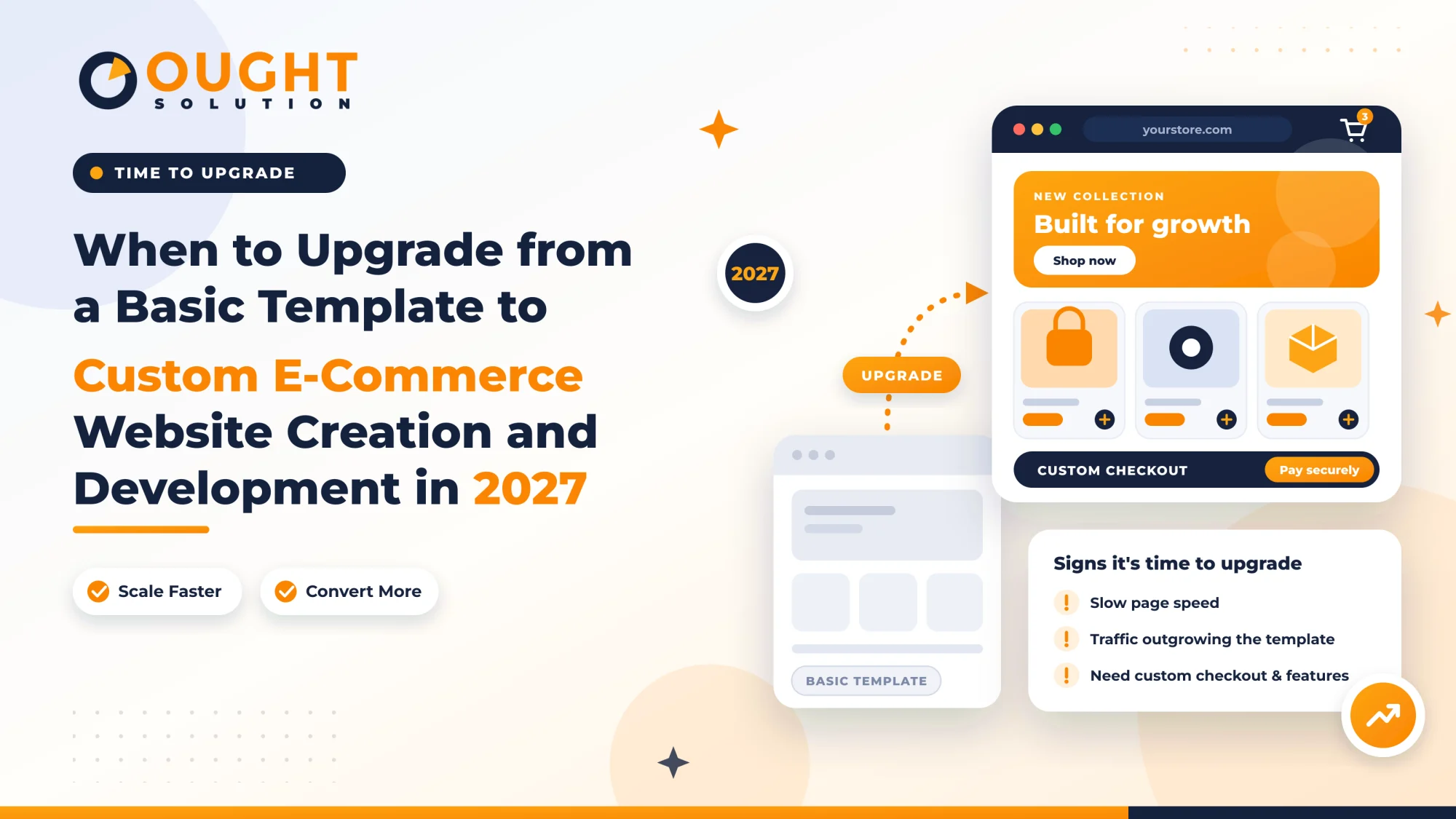
However, growth exposes the structural limits of off-the-shelf platforms. By 2027, online buyers expect instant page loads, hyper-personalized pricing, and frictionless mobile checkouts, while growing sellers require deep backend automation. When your team spends more time building workarounds for plugin conflicts than fulfilling orders, you have hit the template ceiling.
Investing in custom e-commerce website creation and development shifts your store from a rigid digital catalog into a tailored revenue engine. Below are the definitive operational milestones that signal it is time to transition from a basic template to a custom-built architecture.
1. Your Checkout Flow Causes Cart Abandonment
Standard templates force every customer through a one-size-fits-all checkout funnel. While that works for simple B2C apparel or gadget sales, it breaks down the moment your purchasing journey requires nuance:
B2B and Wholesale Tiered Rules: Requiring purchase order (PO) numbers, dynamic bulk-discount matrices, credit-limit checks, or net-30 payment terms before order confirmation.
Custom Product Builders: Selling configurable items (such as custom-cut industrial materials, engraved gifts, or bundled kits) where pricing and shipping weight recalculate dynamically based on user inputs.
Localized Split Payments: Offering hybrid payment methods, partial advance deposits, or region-specific tax exemptions without stacking three separate third-party checkout plugins that slow down page rendering.
Custom development lets you engineer a single-page or conditional checkout tailored strictly to how your buyers purchase, cutting unnecessary form fields and lifting conversion rates.
2. You Need Real-Time ERP, WMS, and Inventory API Integrations
Relying on manual CSV uploads or delayed webhook connectors between your website and your back-office software inevitably leads to overselling, stockouts, and accounting errors.
When your operations scale across multiple warehouses, retail outlets, or manufacturing units, custom e-commerce website creation and development provides direct, two-way API communication with your core systems:
ERP & Accounting Sync: Automatically pushing online invoices, GST/VAT splits, customer ledgers, and return credits directly into platforms like SAP, Tally, Oracle, or Zoho without human data entry.
Live Multi-Warehouse Allocation: Routing an incoming order to the nearest fulfillment center based on live stock levels and automated courier rate shopping.
Automated Procurement Triggers: Generating low-stock alerts or draft supplier purchase orders the instant online inventory crosses a predefined threshold.
3. You Are Launching Multi-Vendor or Franchise Logic
Transforming a single-brand template into a multi-vendor marketplace or a regional franchise network using off-the-shelf add-ons often results in sluggish databases and security vulnerabilities.
A custom e-commerce platform handles complex stakeholder hierarchies natively at the database level:
Automated Commission Splits: Calculating category-specific platform fees, deducting payment gateway charges, and scheduling vendor payouts automatically.
Independent Seller Portals: Giving third-party vendors or regional distributors isolated dashboards to manage their own SKUs, dispatch manifests, and tax reports without exposing global store data.
Geo-Fenced Catalogs: Displaying different product availability, delivery slots, and local pricing depending on the buyer's PIN code or selected franchise store.
4. Plugin Bloat Is Hurting Your Core Web Vitals and SEO
Every time you install a third-party plugin for upsells, reviews, currency conversion, or search filtering on a template site, you add external JavaScript and CSS payloads. Over time, these scripts clash, bloat your Document Object Model (DOM), and degrade Google Core Web Vitals (LCP, INP, and CLS).
Search engines reward fast, clean, semantically structured storefronts. With custom PHP, MySQL, or modern headless architectures, every feature is written specifically for your business logic. You eliminate unused code, maintain sub-second server response times, and gain total control over technical SEO—including custom URL structures, automated JSON-LD product schema, and faceted navigation indexing.
5. Rising SaaS Transaction Fees Are Eating Your Margins
Hosted template platforms often look affordable at launch, but their pricing models penalize scale. As your Gross Merchandise Value (GMV) grows, mandatory platform revenue shares, per-transaction surcharges for using external payment gateways, and recurring monthly subscriptions for dozens of essential apps compound rapidly.
Owning a custom-built e-commerce codebase turns recurring software rent into a long-term business asset. You pay zero platform transaction penalties, choose the payment gateways with the lowest MDR (Merchant Discount Rate) for your region, and scale server infrastructure strictly in proportion to actual traffic.
Quick Comparison: Basic Template vs. Custom E-Commerce Architecture
| Operational Area | Basic E-Commerce Template | Custom E-Commerce Development |
| Checkout Experience | Fixed steps; limited customization via heavy plugins | Fully bespoke, conditional flows for B2C, B2B, and custom bundles |
| ERP & Inventory Sync | Relies on third-party connectors or manual CSV imports | Direct, real-time bi-directional REST/GraphQL API integration |
| Multi-Vendor Capabilities | Clunky add-ons with shared database bottlenecks | Native vendor isolation, automated commission splits, and geo-routing |
| Page Speed & SEO | Slowed down by bloated theme scripts and rigid URL rules | Clean codebase, optimized Core Web Vitals, and granular schema control |
| Long-Term Cost | Escalating app subscriptions and GMV transaction fees | One-time development investment with predictable hosting costs |
Partner with Ought Solution for Custom E-Commerce Engineering
Upgrading your digital storefront does not mean disrupting your daily sales. At Ought Solution, we specialize in end-to-end custom e-commerce website creation and development engineered for speed, security, and seamless backend automation.
Whether you need a custom PHP/MySQL storefront built from the ground up, complex ERP and inventory API integrations, or a scalable multi-vendor marketplace, our engineering team handles architecture, data migration, payment gateway integration, and technical SEO under one roof.
Ready to build an e-commerce platform without template limits? Reach out to the Ought Solution team today to map out your custom architecture and technical roadmap for 2027.

Ought Solution Admin is the technical editorial and solutions architecture desk at Ought Solution, a global B2B IT consulting, custom ERP software, and biometric hardware integration firm. Drawing from hands-on deployments across Manufacturing Units / Plants, healthcare diagnostics, educational campuses, and corporate…