Launching a business online has never been faster. Drag-and-drop builders like Wix and open-source content management systems like WordPress allow founders to go from an idea to a live URL in a single weekend. For early-stage validation, solo creators, and local brochure sites, these platforms do their job well.
However, as a brand enters a high-growth phase heading into 2027, the very tools that accelerated your launch often become the primary bottlenecks holding back revenue. Search engines are stricter about Core Web Vitals, cyber threats targeting common CMS vulnerabilities are more automated, and modern businesses rely on deeply integrated software workflows rather than static web pages.
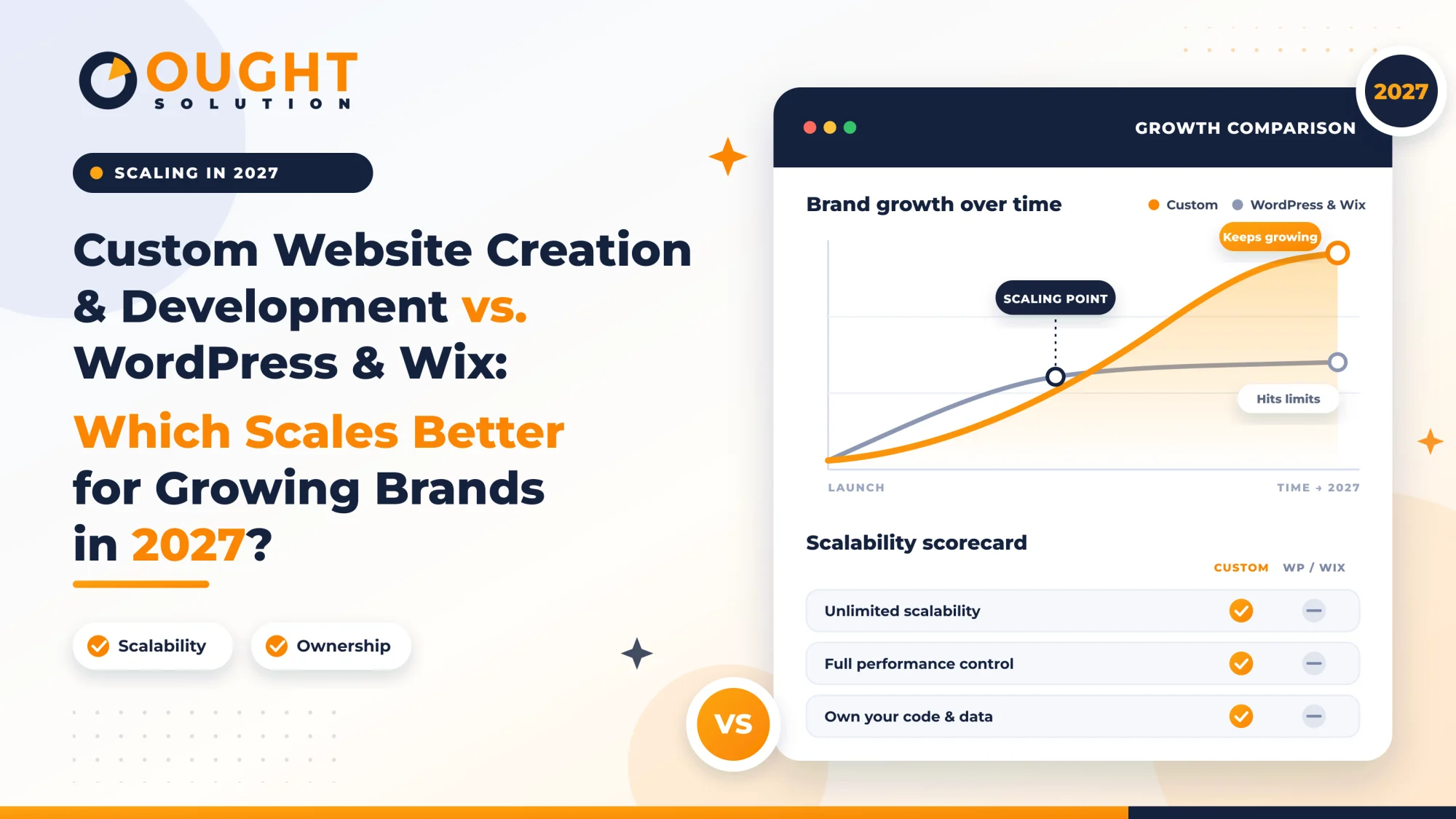
When evaluating custom website development vs WordPress and Wix, the decision comes down to one core question: Are you building a digital brochure, or are you building scalable business infrastructure?
1. Performance & Core Web Vitals: Clean Code vs. Script Bloat
Google’s ranking algorithms and modern user behavior leave zero room for sluggish load times. A delay of even half a second on mobile devices noticeably increases bounce rates and lowers conversion metrics.
Wix: Because Wix is a closed, hosted ecosystem built to accommodate thousands of visual drag-and-drop combinations, every page loads a heavy baseline of proprietary JavaScript and CSS frameworks. You cannot strip out unused code at the server level, which frequently caps mobile PageSpeed scores once you add tracking pixels, animations, or third-party widgets.
WordPress: While WordPress core is lightweight, real-world business sites rarely run on core alone. Achieving modern functionality typically requires a page builder (like Elementor or Divi) plus 15 to 30 third-party plugins. Each plugin injects its own stylesheets, database queries, and scripts, creating render-blocking bloat that degrades Interaction to Next Paint (INP) and Largest Contentful Paint (LCP).
Custom Website Development: A custom-built website—engineered using clean HTML5, modular CSS, optimized JavaScript, or modern full-stack frameworks backed by a dedicated relational database—loads only the exact code required for that specific view. Assets are compressed, database queries are indexed, and server-side caching is tailored to your exact traffic patterns, routinely achieving 95+ Core Web Vitals scores out of the box.
2. Custom Workflows, ERP Sync & API Integrations
Growing brands rarely operate in isolation. By 2027, competitive companies connect their websites directly to internal operations—whether that means syncing real-time inventory, automating customer onboarding, generating dynamic invoices, or connecting web portals with CRM, payroll, and attendance ecosystems.
Wix: Limited to native Wix App Market integrations and restricted Velo scripting environments. If your business logic does not fit Wix’s predefined database schemas or checkout flows, you are forced to duct-tape external automation tools (like Zapier) at high recurring monthly costs.
WordPress: Relies heavily on off-the-shelf plugins. When a plugin covers 80% of your workflow, customizing the remaining 20% often requires fragile PHP hooks that risk breaking every time the plugin author pushes an update.
Custom Website Development: Built around your exact operational logic from day one. Whether you need a custom client portal, automated multi-tier pricing calculators, custom REST API endpoints, or direct two-way synchronization with your internal ERP and database systems, bespoke development turns your website into an active operational engine rather than a passive storefront.
3. Security Posture & Long-Term Maintenance
Cybersecurity in 2027 is dominated by automated bots scanning the internet for known signatures of popular platforms.
WordPress: Powering over 40% of the web makes WordPress the number-one target for automated exploits. The core software is secure, but third-party themes and abandoned plugins create massive attack surfaces. One outdated contact form or slider plugin can compromise your entire database.
Wix: Offers strong managed security because the platform is closed. However, that same closed nature means you have zero control over server configuration, custom firewall rules, or data residency compliance if your industry scales into strict regulatory territory.
Custom Website Development: Eliminates mass-market vulnerability signatures. Because your codebase is proprietary and free of public third-party plugins, automated CMS exploit bots have nothing standard to target. Developers implement hardened authentication, parameterized SQL queries, strict Content Security Policies (CSP), and custom role-based access controls tailored to your internal team.
4. Technical SEO & Structured Data Control
Ranking globally requires more than publishing blog posts; it demands surgical control over technical SEO architecture.
Drag-and-Drop & Template Builders: Often generate nested, bloated DOM structures (
<div>soup), rigid URL hierarchies, and generic schema markup injected via heavy tag managers.Custom Web Architecture: Gives your SEO strategy complete freedom. You control semantic HTML tags, clean URL routing, dynamic XML sitemaps, server-rendered metadata, and native JSON-LD Schema Markup embedded directly into the page source—ensuring search engines and AI answer engines parse your services, FAQs, and entity relationships with maximum clarity.
Side-by-Side Comparison: Scaling Into 2027
| Evaluation Factor | Wix (Drag-and-Drop) | WordPress (Plugin CMS) | Custom Website Development |
| Initial Launch Speed | Fast (Days) | Moderate (Weeks) | Structured (Weeks to Months) |
| Page Speed & Core Web Vitals | Constrained by platform scripts | Degrades as plugins accumulate | Maximum speed; zero bloat |
| Custom Business Workflows | Very limited | Workarounds via plugins/hooks | 100% tailored to your logic |
| Security & Vulnerability Risk | Managed, closed environment | High if plugins aren't maintained | Hardened, no public plugin flaws |
| Technical SEO & Schema Control | Basic to intermediate | Good with heavy SEO plugins | Granular, native code-level control |
| 3-to-5 Year Total Cost | Rising subscription & app fees | Maintenance, hosting & plugin renewals | Predictable ownership; zero license tax |
When Should Your Brand Make the Switch?
You do not always need a custom build on day one—but staying on a template platform too long silently taxes your marketing budget through lower ad conversion rates, lost organic rankings, and manual administrative work.
Stick with Wix or basic WordPress if:
You are testing a brand-new concept with a limited initial budget.
Your site has fewer than 15 static pages and requires no custom user portals or complex database logic.
Invest in Custom Website Development if:
Page load delays or mobile Core Web Vitals warnings are hurting your Google rankings and paid ad ROI.
Your team wastes hours manually moving data between your website and your CRM, ERP, billing, or inventory tools.
You are building a SaaS product, multi-vendor marketplace, booking engine, or high-traffic enterprise platform.
You want 100% intellectual property ownership of your codebase without recurring per-feature plugin subscriptions.
Build Future-Ready Web Infrastructure with Ought Solution
Your website should never force your business to compromise on speed, security, or operational workflows. At Ought Solution, we engineer high-performance custom websites, full-stack web applications, and integrated enterprise automation systems designed to scale seamlessly into 2027 and beyond.
Whether you are migrating away from a sluggish WordPress setup or architecting a custom digital platform from the ground up, our engineering team delivers clean code, technical SEO precision, and tailored integrations built around your business goals.
Ready to outgrow templates? Contact Ought Solution (oughtsolution.com) today for a technical architecture consultation and discover what a purpose-built website can do for your brand.

Ought Solution Admin is the technical editorial and solutions architecture desk at Ought Solution, a global B2B IT consulting, custom ERP software, and biometric hardware integration firm. Drawing from hands-on deployments across Manufacturing Units / Plants, healthcare diagnostics, educational campuses, and corporate…