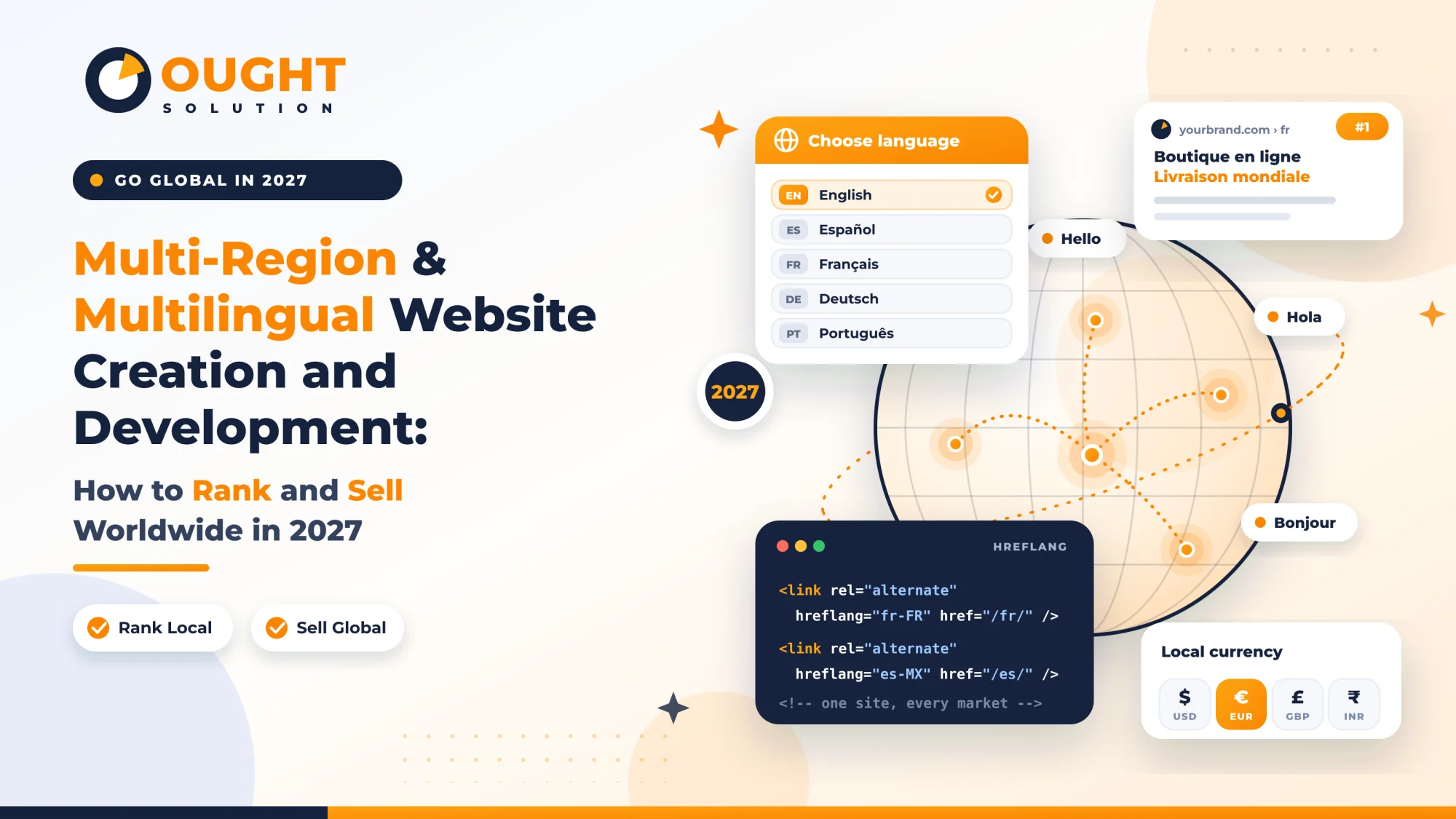
Expanding a business across borders in 2027 requires far more than adding an automated translation plugin to an existing storefront. International buyers expect storefronts that load instantaneously in their region, speak their native dialect naturally, display familiar currencies, and integrate local payment gateways. Without a deliberate technical foundation, global expansion efforts often stall due to duplicate content penalties, slow cross-continental load times, and abandoned checkouts.
Investing in professional multilingual website creation and development bridges the gap between local operations and worldwide revenue. When engineered correctly, a multi-region web platform signals relevance to search engines in every target market while giving international visitors a seamless, trustworthy buying experience.
Why Translation Alone Fails in Global Markets
Many organizations assume translating product descriptions into Spanish, German, Arabic, or Japanese is enough to capture overseas demand. In practice, raw word-for-word translation creates friction across both search visibility and user conversion:
Search Engine Cannibalization: Without explicit regional targeting, Google and regional search engines struggle to decide whether to serve your US, UK, Australian, or Indian English pages—often suppressing all of them in search rankings.
Cultural and Linguistic Mismatches: idioms, measurement units (imperial vs. metric), date formats, and right-to-left (RTL) reading layouts require structural UI adaptation, not just text swaps.
Checkout Drop-Off: Global shoppers routinely abandon carts when prices appear only in USD or when familiar regional payment methods—such as UPI, SEPA, Klarna, or local digital wallets—are missing at checkout.
Core Technical Pillars of Multi-Region Web Development
Building an international digital flagship requires aligning server infrastructure, URL architecture, and frontend engineering from day one.
1. Choosing the Right Global URL Architecture
Your domain structure dictates how search engines distribute domain authority and how easily your engineering team can scale into new territories:
| URL Structure | Example | Best Use Case | SEO & Maintenance Impact |
| Subdirectories (gTLD) | [oughtsolution.com/de/](https://oughtsolution.com/de/) | Most global B2B and e-commerce brands | Consolidates domain authority under one root domain; easiest to manage and scale. |
| Subdomains | de.oughtsolution.com | Enterprises with distinct regional tech stacks | Allows separate server hosting per region, though search engines may treat subdomains semi-independently. |
| Country-Code TLDs (ccTLDs) | oughtsolution.de | Large corporations with dedicated local teams | Strongest local trust signal, but requires building separate backlink profiles and SEO authority for every country. |
For most growing enterprises, subdirectories on a strong generic top-level domain (.com) provide the fastest path to ranking globally because every regional folder benefits from the core domain's existing authority.
2. Precision Hreflang Tag Implementation
The hreflang attribute acts as a routing map for search crawlers, telling Google which language and regional variant to display based on a searcher's location and browser settings. A properly configured implementation includes:
Bidirectional Return Links: Every localized page must reference itself and every alternate regional version. If your English page points to your French page, the French page must point back.
ISO Language and Region Codes: Combining ISO 639-1 language codes with ISO 3166-1 Alpha-2 country codes (such as
en-gb,en-in,es-mx, orfr-ca) prevents duplicate-content confusion across regions sharing a common language.The
x-defaultFallback: Defining anx-defaulttag ensures visitors from unmapped countries land on a clean global selector or primary international storefront rather than hitting a dead end.
3. Global Edge CDN and Core Web Vitals
Distance directly impacts latency. If your origin server sits in a single data center, a customer browsing from Europe, Southeast Asia, or North America experiences noticeable delays that hurt both Core Web Vitals and conversion rates.
Modern multi-region development pairs clean, lightweight backend code with a globally distributed Content Delivery Network (CDN) and edge caching. By serving static assets, localized media, and cached HTML from edge nodes closest to the user, Time to First Byte (TTFB) stays consistently low worldwide—protecting your search rankings across every geographic market.
Designing Localized UX That Converts Worldwide Buyers
Technical visibility brings international traffic to your site; localized user experience turns those visitors into paying customers.
Dynamic Currency and Tax Localization: Display prices in the shopper's local currency with transparent regional tax calculations (such as VAT or GST) well before the final payment screen.
Bidirectional Layout Engineering (LTR & RTL): Supporting languages like Arabic or Hebrew requires mirroring navigation bars, grids, icons, and form alignments using logical CSS properties rather than quick visual overrides.
Non-Intrusive Geolocation Routing: Automatically detecting a visitor's IP address to suggest their local storefront—via a clean top banner rather than a forced redirect—respects user choice while ensuring search engine bots can still crawl every regional URL freely.
Localized Structured Data (JSON-LD): Embedding region-specific
Organization,Product,Offer, andFAQPageschema markup helps search engines surface rich snippets with accurate local pricing and availability.
How Ought Solution Builds Scalable Global Web Platforms
At Ought Solution, we engineer custom websites, enterprise portals, and e-commerce ecosystems built from the ground up for international growth. Rather than relying on bloated plugins that slow down page speed and break technical SEO, our development team builds clean, modular architectures tailored to your expansion roadmap:
Custom Multi-Region Architecture: Clean database schemas and modular frontends capable of managing dozens of languages, currencies, and regional catalogs from a single unified admin dashboard.
Technical SEO Built Into the Codebase: Automated XML sitemaps per locale, error-free
hreflanggeneration, canonical tag governance, and localized JSON-LD schema markup.High-Speed Performance Optimization: Lean PHP, JavaScript, and modern cloud hosting configurations tuned for global CDN delivery and top Core Web Vitals scores.
End-to-End Business Automation: Seamless integration with international payment gateways, ERP systems, inventory trackers, and CRM workflows so cross-border orders flow smoothly from click to fulfillment.
Ready to Take Your Brand Global in 2027?
Whether you are launching your first international storefront or migrating an existing platform onto a faster, SEO-ready multi-region architecture, our team can design and build a solution tailored to your target markets.
Partner with Ought Solution to turn your website into a high-ranking, high-converting global sales engine. Explore our custom web development and digital engineering services at oughtsolution.com to start planning your 2027 international rollout.

Ought Solution Admin is the technical editorial and solutions architecture desk at Ought Solution, a global B2B IT consulting, custom ERP software, and biometric hardware integration firm. Drawing from hands-on deployments across Manufacturing Units / Plants, healthcare diagnostics, educational campuses, and corporate…