Ought Solution
Biometric & Access Control

AI Liveness Detection & Anti-Spoofing in Biometric Attendance: Stopping Photo, Video & Silicone Proxy Punches in 2027

Legacy biometric machines are easily fooled by high-resolution phone videos, printed photos, and molded silicone fingertips. Discover how AI liveness detection, dual-lens IR/RGB cameras, and touchless palm vein technolo…

OAOught Solution AdminAuthor5 min read
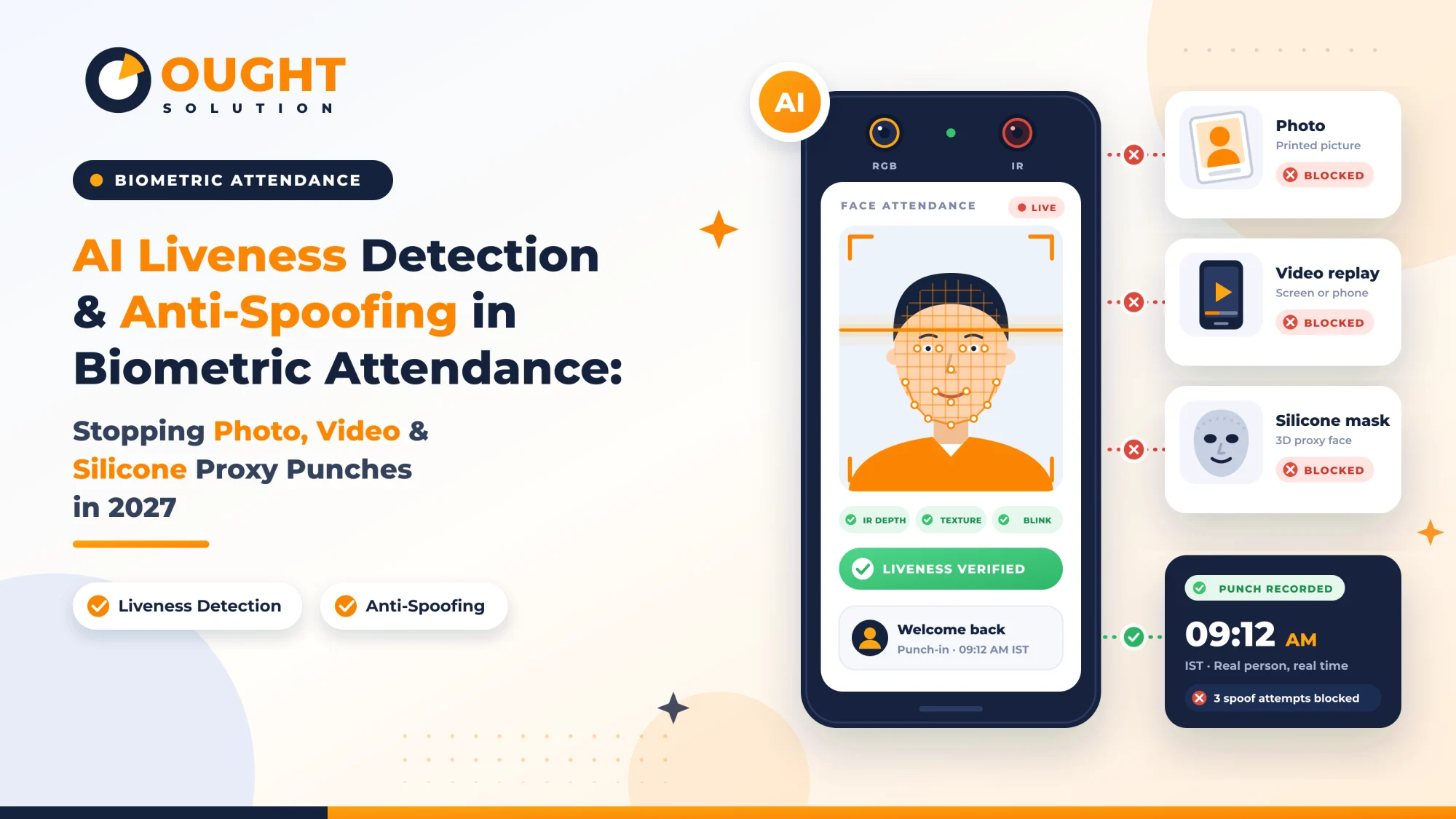
Dual-lens infrared and RGB AI facial recognition biometric attendance terminal scanning an employee's face with real-time liveness detection grid to block photo and video spoofing in an Indian corporate office.

For years, installing a basic fingerprint or entry-level face scanner was enough to deter buddy punching. By 2027, however, workplace proxy tactics have evolved alongside consumer technology. Across Indian manufacturing plants, construction sites, hospitals, and corporate offices, HR and compliance teams face a costly reality: older single-lens facial terminals can be tricked by a clear smartphone photo or looped video, while legacy optical fingerprint scanners remain vulnerable to molded silicone or gelatin fingertip replicas.

When even 3% to 5% of shift punches are fraudulent, the resulting payroll leakage, inflated overtime payouts, and compliance audit failures quickly outweigh the cost of hardware upgrades. This is why biometric attendance liveness detection and anti-spoofing in India has shifted from a "nice-to-have" feature to a mandatory enterprise procurement requirement in 2027.

What Is AI Liveness Detection & Anti-Spoofing?

Liveness detection is the ability of a biometric sensor to verify that a physical characteristic belongs to a living, breathing human standing in front of the terminal—not a static photograph, a digital screen replay, a 3D-printed mask, or a synthetic fingerprint cast.

Anti-spoofing refers to the combined hardware sensors and neural network algorithms that actively detect and reject presentation attacks (known globally under the ISO/IEC 30107-3 Presentation Attack Detection standard) in less than a second, without slowing down shift-change queues.

The 3 Most Common Proxy Punch Attacks in Indian Workplaces

Before selecting hardware, procurement and IT heads must understand how legacy terminals are bypassed on the ground:

  • 2D Photo & Smartphone Screen Replay Attacks: An employee sends a selfie or a 3-second blinking video to a colleague on WhatsApp. The colleague holds the phone screen up to an older single-camera face attendance machine, which matches facial geometry and logs an "IN" punch.

  • Silicone, Latex & Gelatin Fingerprint Molds: In high-turnover contract labor environments, workers sometimes press their finger into putty or silicone to create a wearable skin-toned replica that passes basic optical sensors lacking capacitive or sub-dermal verification.

  • GPS & Selfie Spoofing on Mobile Apps: Field staff use mock-location apps or photograph a desktop monitor to bypass basic mobile attendance tools.

How Modern Anti-Spoofing Hardware Blocks Fake Punches

Enterprise-grade terminals supplied by Ought Solution combine multi-spectral hardware with on-device Edge AI to neutralize spoofing at the point of capture:

Attack VectorWhy Legacy Devices Fail2027 Anti-Spoofing Defense
Printed Photos & Phone VideosSingle RGB cameras only measure 2D pixel ratios and surface landmarks.Dual-Lens IR + RGB Stereo Cameras capture 3D facial depth maps and infrared heat/reflectance signatures—screens and paper appear completely flat under IR and are rejected instantly.
3D Masks & Deepfake ReplaysBasic motion checks (like "blink now") can be fooled by recorded videos.Passive AI Texture & Micro-Movement Analysis evaluates skin pore reflectance, moiré screen patterns, and involuntary micro-expressions in under 0.3 seconds with zero user friction.
Silicone & Fake FingerprintsStandard optical sensors only capture surface ridge patterns.Live-Body Capacitive & Multi-Modal Verification checks sub-dermal conductivity and pairs fingerprint scans with live facial or RFID confirmation.
Worn Fingerprints (Factory/Shopfloor)Grease, dust, or worn skin causes false rejections, forcing HR to allow manual overrides.Touchless Palm Vein Recognition reads internal hemoglobin patterns beneath the skin using near-infrared light—impossible to forge and unaffected by surface dirt.

Key Features to Mandate in Your 2027 Biometric RFP

If your organization is upgrading terminals or issuing a tender in 2027, ensure these five non-negotiable specifications are written into your procurement checklist:

  1. Dual-Lens Wide Dynamic Range (WDR) IR + RGB Cameras: Essential for Indian entrances exposed to harsh sunlight, glass lobbies, or dim night-shift lighting. Terminals like the Ought Solution OU-F22 and OU-BM60W Pro pair infrared and visible-light optics with day/night LED arrays to block photo and video spoofing while maintaining sub-second recognition even with spectacles, safety helmets, or masks.

  2. Touchless Palm + Face Multi-Modal Support: For factories, warehouses, and healthcare facilities, combining contactless palm recognition with AI face detection eliminates hygiene concerns and solves worn-fingerprint failures without compromising security.

  3. Edge-Based Offline Processing & Buffer Storage: Anti-spoofing must run locally on the device's NPU (Neural Processing Unit), not over a slow cloud round-trip. Look for local storage of 100,000+ offline logs and built-in battery backup so power cuts or internet drops never halt shift entry or force manual register entries.

  4. Real-Time ADMS / Cloud Push API Sync: Security is incomplete if logs sit isolated on a device. Ensure terminals push verified punch data via encrypted ADMS / Cloud Push API directly into your Smart Attendance & Payroll System or third-party ERP in under 2 seconds.

  5. DPDP Act 2023 Data Encryption Compliance: Biometric templates must be stored as irreversible, encrypted mathematical hashes rather than raw facial photographs, protecting employee privacy under India's Digital Personal Data Protection (DPDP) framework.

Eliminate Payroll Leakage with Ought Solution

Upgrading to anti-spoofing biometric hardware pays for itself within months by eliminating ghost workers, overtime manipulation, and manual attendance reconciliation.

Ought Solution supplies, configures, and supports end-to-end Biometric Time & Attendance Systems—from dual-lens AI facial terminals (OU-F22, OU-BM60W Pro, OU-BM70W Pro) and touchless palm readers to electromagnetic door locks and cloud-connected payroll ERP software.

Ready to audit your current attendance setup against spoofing vulnerabilities? Contact Ought Solution for a free site consultation, live hardware demo, or bulk enterprise quote today.

Enjoyed this? Share it
Ought Solution Admin
Written byOught Solution Admin

Ought Solution Admin is the technical editorial and solutions architecture desk at Ought Solution, a global B2B IT consulting, custom ERP software, and biometric hardware integration firm. Drawing from hands-on deployments across Manufacturing Units / Plants, healthcare diagnostics, educational campuses, and corporate…
FAQ

Frequently asked questions

What is biometric attendance liveness detection and anti-spoofing?

Biometric attendance liveness detection and anti-spoofing is a combination of dual-lens optical sensors (Infrared + RGB) and on-device AI algorithms that verify whether a scan comes from a real, living person standing at the terminal. It automatically detects and blocks proxy attempts made using printed photographs, smartphone video replays, 3D masks, or molded silicone fingertips in under a second.

Why is liveness detection mandatory for biometric procurement in India in 2027?

Legacy single-camera facial devices and basic optical fingerprint scanners are easily bypassed using high-resolution smartphone screens and synthetic fingertip molds, causing 3% to 5% payroll leakage and compliance audit risks. In 2027, Indian enterprises, factories, hospitals, and government contractors mandate AI anti-spoofing in RFPs to eliminate ghost workers, prevent overtime manipulation, and maintain tamper-proof attendance logs.

Can an AI anti-spoofing attendance machine be fooled by a smartphone video or WhatsApp photo?

No. Enterprise terminals equipped with Dual-Lens IR (Infrared) + RGB Stereo Cameras capture 3D facial depth maps and infrared heat/reflectance signatures alongside skin-texture analysis. Because a smartphone screen or printed photo lacks real 3D facial contours and emits flat infrared light, the terminal flags it as a presentation attack and rejects the punch immediately.

How do touchless palm vein scanners prevent silicone and worn-fingerprint issues?

In factories, warehouses, and construction sites, grease, dust, or worn skin often cause traditional fingerprint scanners to fail—or tempt workers to use silicone molds. Touchless palm vein recognition uses safe near-infrared light to map the unique hemoglobin vein pattern beneath the skin's surface. Because internal blood flow cannot be replicated with silicone or latex and is unaffected by surface dirt, it guarantees 100% hygienic, spoof-proof verification.

Does AI liveness detection slow down shift-change queues for large workforces?

Not on modern Edge-AI hardware. Terminals like the Ought Solution OU-F22 and OU-BM60W Pro run passive liveness detection directly on a built-in Neural Processing Unit (NPU)—meaning employees do not need to blink, nod, or pause awkwardly. Verification happens automatically as they walk up to the device in less than 0.3 seconds, smoothly handling high-volume factory and corporate shift changes.

Does biometric liveness detection work offline during internet or power outages?

Yes. Because anti-spoofing calculations happen locally on the terminal's embedded processor rather than relying on cloud servers, liveness verification works 100% offline. Devices store over 100,000+ encrypted attendance logs locally, include optional battery backup, and automatically sync punches to your payroll software via ADMS / Cloud Push API the moment connectivity resumes.

Are anti-spoofing biometric attendance systems compliant with India’s DPDP Act?

Yes, when properly configured. Modern enterprise biometric systems convert facial and palm scans into encrypted, irreversible mathematical templates rather than storing raw photographs, ensuring employee biometric data remains protected under India's Digital Personal Data Protection (DPDP) Act guidelines.

What is the difference between active and passive liveness detection in attendance machines?

Active liveness detection forces the employee to perform a specific action—such as blinking, turning their head, or smiling—which creates queues of 3 to 5 seconds per person during shift changes. Passive liveness detection uses dual-lens IR/RGB depth sensing and skin-texture AI to verify human presence silently in the background as the user walks up, completing verification in under 0.3 seconds with zero user effort.

What is ISO/IEC 30107-3 Presentation Attack Detection (PAD) certification?

ISO/IEC 30107-3 is the global testing benchmark that measures how reliably a biometric device detects and blocks spoof attacks (Presentation Attack Detection) such as printed photos, HD video replays, and 3D silicone masks. When issuing an RFP in 2027, requiring ISO/IEC 30107-3 (Level 1 or Level 2) compliant anti-spoofing ensures the terminal has passed standardized independent lab testing rather than basic software filters.

Can AI facial recognition attendance work accurately with spectacles, helmets, beards, or low lighting?

Yes. Enterprise terminals equipped with Wide Dynamic Range (WDR) Dual-Lens IR + RGB cameras and auto-adjusting infrared LEDs isolate core facial geometry (eyes, nose bridge, and cheek structure) regardless of harsh sunlight, dim night shifts, prescription glasses, safety helmets, or facial hair changes.

What happens if an employee refuses biometric enrollment under India's DPDP Act?

Under India’s Digital Personal Data Protection (DPDP) Act and Rules, biometric collection requires clear purpose-limited notice, and organizations should provide an approved non-biometric fallback—such as an encrypted RFID/NFC smart card or supervisor-verified PIN—for employees with valid medical or consent exemptions. Modern multi-modal terminals from Ought Solution support Face + Palm + RFID on a single device.

How long should employee biometric templates and attendance logs be retained in India?

Compliance best practices separate the two records:

  • Encrypted Biometric Templates: Purge immediately when an employee exits the organization or withdraws consent, and never store raw facial photographs.

  • Attendance & Wage Registers: Retain timestamped punch logs and shift hours for at least 5 years to satisfy statutory labor audits under the Code on Wages rules.

Can anti-spoofing biometric attendance machines also control door locks and turnstiles?

Yes. Most enterprise terminals—such as the Ought Solution OU-BM60W Pro and OU-F22—include built-in Wiegand In/Out and relay interfaces that connect directly to electromagnetic locks, flap barriers, and tripod turnstiles. Only an employee who passes live anti-spoofing verification is granted physical door access and logged into payroll simultaneously.

How do we test if a biometric vendor's anti-spoofing actually works before buying?

During your live vendor demo, run a 3-step spoof audit before signing a PO:

  1. Hold up a high-resolution photo and a 4K video of an enrolled employee on a flagship smartphone screen.

  2. Test verification in direct doorway sunlight and a dark corridor.

  3. Disconnect the Ethernet/Wi-Fi cable to confirm offline liveness detection and local log buffering still work without slowing down punches.

How much does an AI anti-spoofing biometric attendance machine cost in India in 2027?

In India, entry-level optical devices cost ₹3,000–₹8,000 but lack true hardware liveness detection. Enterprise Dual-Lens IR + RGB AI Facial and Touchless Palm terminals with true anti-spoofing typically range from ₹9,500 to ₹35,000 per terminal depending on user capacity (3,000 to 50,000+ faces), battery backup, and cloud HRMS/payroll integration. Contact Ought Solution for volume pricing and site-specific hardware recommendations.

Keep reading

More articles

Tell us what you need - we will suggest the right solution

Free consultation. A clear proposal within 24 hours.

Contact us