Launching a startup on a drag-and-drop platform feels effortless on day one. You pick a template, connect a credit card, and go live in a weekend. Fast-forward twelve months, and the math looks very different: CMS item limits trigger sudden plan upgrades, essential features require five different third-party apps, bandwidth overages spike during a product launch, and you still do not own a single line of backend code.
That exact friction is why the debate around custom website creation and development vs SaaS builders has shifted sharply among international founders. Today, growth-stage startups and B2B companies are moving away from rented platforms like Webflow, Shopify, and Wix in favor of 100% source-code ownership built on proven, scalable stacks like Linux, PHP, and MySQL.
Here is a practical breakdown of where recurring SaaS builders break down, how a custom build protects your margins and valuation, and how to decide which architecture fits your roadmap.
The Hidden Cost of "Low-Cost" SaaS Website Builders
SaaS website builders market themselves on low entry pricing, but their business model relies on expansion revenue. As your traffic, team size, and feature requirements grow, costs compound across four areas:
Tiered Plan Escalation: Moving from a starter tier to a business or enterprise tier to unlock custom roles, staging environments, or higher CMS record limits can jump your bill from $29/month to $300–$2,000+/month overnight.
The Plugin and App Tax: Need multi-currency invoicing, custom quote calculators, gated client portals, or advanced SEO schema? On Shopify, Wix, and Webflow, every missing native feature becomes another $15–$99/month subscription.
Transaction and Bandwidth Fees: Many SaaS platforms penalize success through per-transaction surcharges (when using external payment gateways) or steep bandwidth overage bills when a marketing campaign goes viral.
Redesign Lock-In: When you outgrow a SaaS builder, you cannot simply pack up your database, server logic, and dynamic templates and move them to your own cloud server. You are forced to rebuild from scratch.
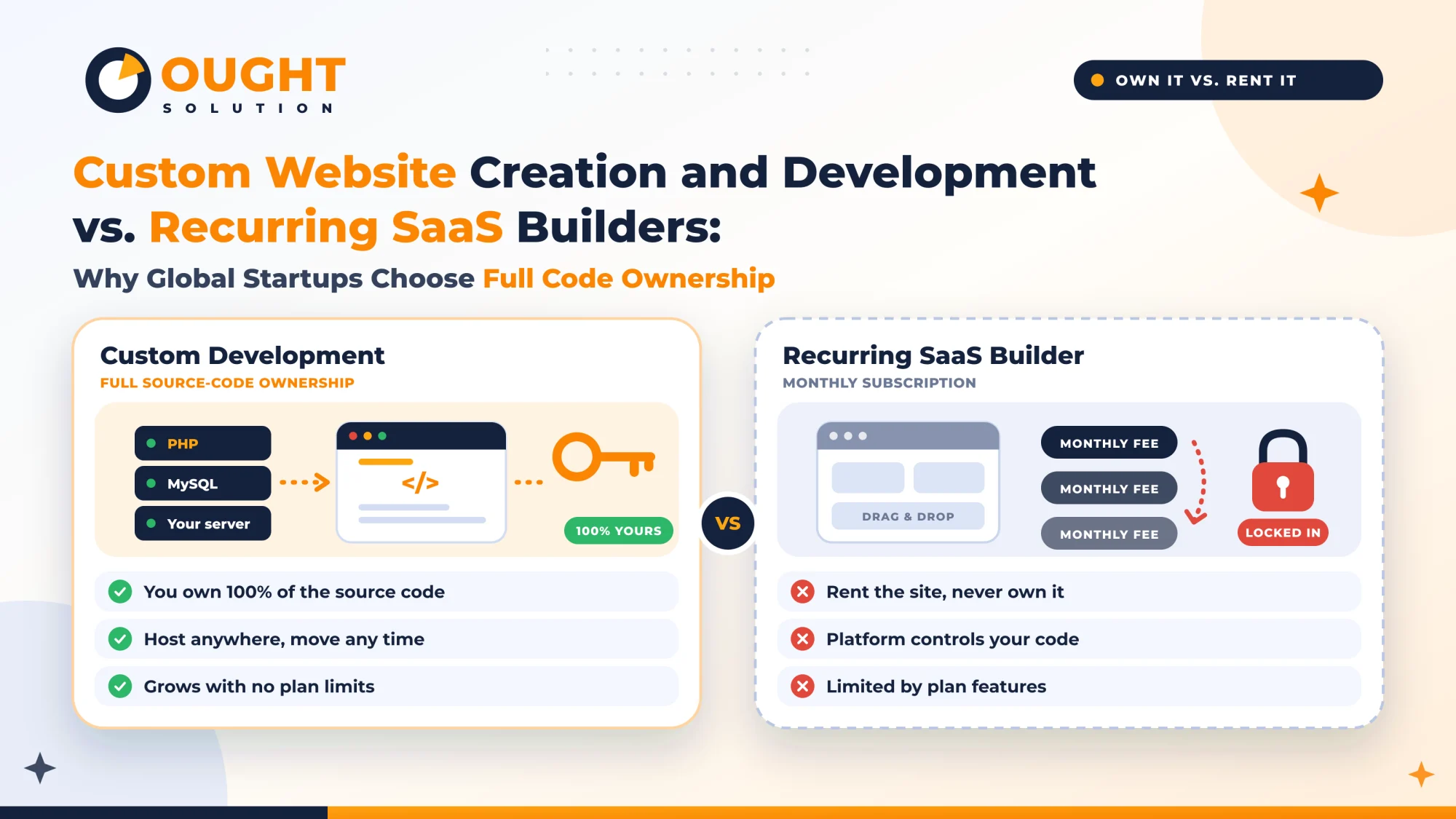
When founders compare custom website creation and development vs SaaS builders over a 36-month window, the "cheap" monthly subscription frequently ends up costing more than a bespoke build—without leaving the company with a transferable digital asset.
Why Full Code Ownership Matters to Global Startups
Owning your codebase is not just a technical preference; it is a financial and strategic advantage.
1. Your Website Becomes Intellectual Property (IP)
During investor due diligence, acquisitions, or enterprise procurement audits, renting your core web platform on a closed SaaS ecosystem raises questions about scalability and vendor dependency. With custom website creation and development, every file—frontend templates, backend controllers, API endpoints, and database schemas—belongs 100% to your company.
2. Zero Vendor Lock-In and Portable Hosting
A custom website built on a clean PHP and MySQL stack can run on virtually any Linux VPS, dedicated server, or cloud provider (AWS, DigitalOcean, Vultr, Hetzner, or local regional data centers). If your hosting provider raises prices or you need to comply with regional data residency laws (such as GDPR in Europe or data localization rules in India and the Middle East), you migrate your server in hours—not months.
3. Unrestricted Integrations and Custom Business Logic
Real businesses rarely fit inside generic templates. Startups regularly need their website to talk directly to internal ERPs, inventory systems, custom CRMs, WhatsApp automation APIs, or proprietary SaaS dashboards. Custom development lets you write direct, secure server-side integrations without fragile no-code webhooks breaking every time a third-party app updates.
4. Technical SEO and Core Web Vitals Control
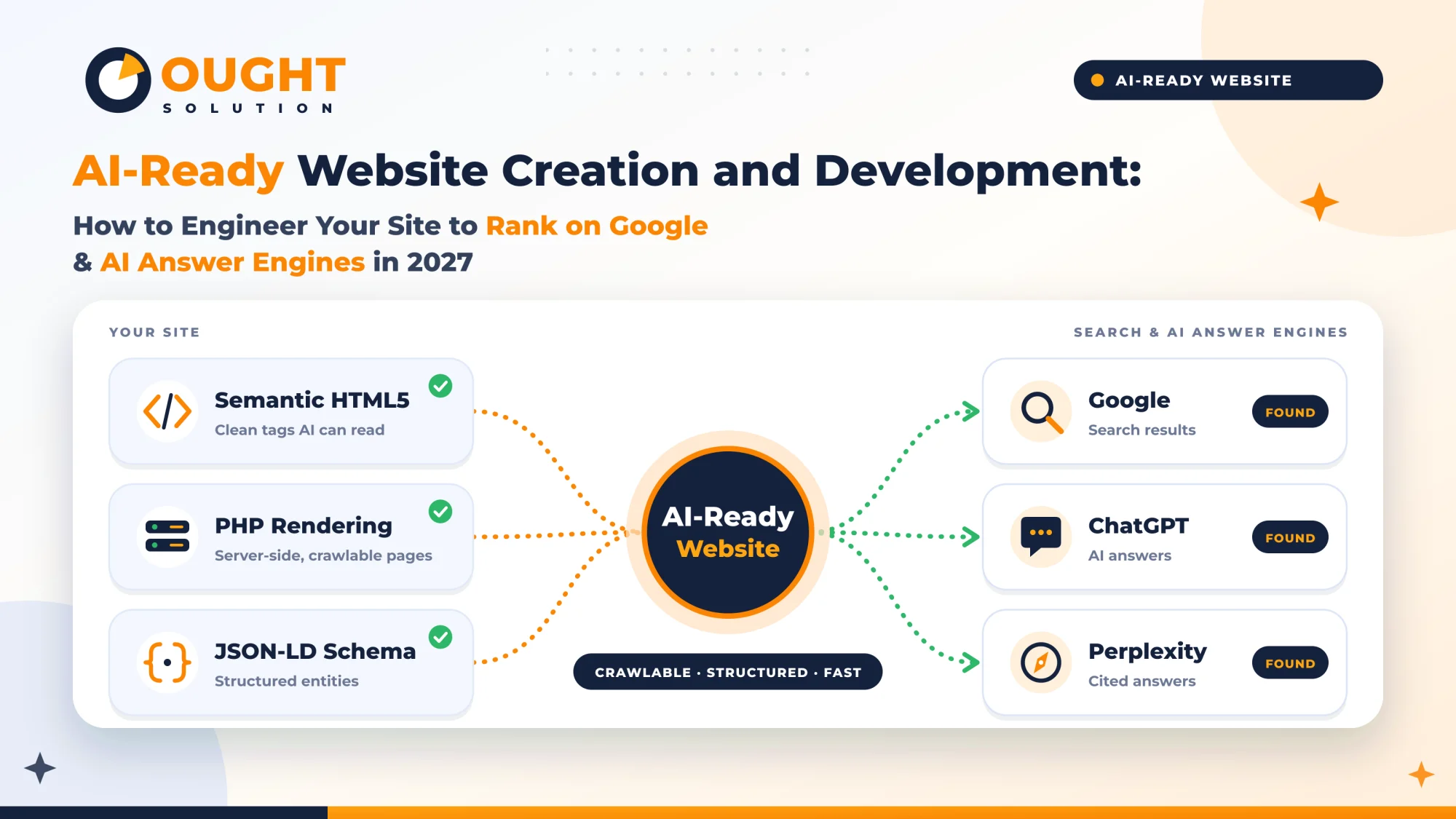
SaaS builders inject heavy JavaScript bundles, unused CSS frameworks, and rigid URL structures (such as forced /pages/ or /products/ prefixes) that drag down mobile PageSpeed scores. A custom-coded website gives you full authority over:
Clean, semantic HTML5 and lightweight asset loading.
Custom URL routing, dynamic canonical tags, and automated XML sitemaps.
Granular JSON-LD structured data (Product, FAQ, Organization, and Article schema).
Server-level caching and database query optimization for sub-second Time to First Byte (TTFB).
Custom Website Creation and Development vs SaaS Builders: 3-Year Comparison
| Factor | Custom Website (PHP / MySQL Stack) | Recurring SaaS Builders (Webflow / Shopify / Wix) |
| Source Code Ownership | 100% owned by your business | Rented; proprietary backend stays with vendor |
| Upfront Investment | One-time development build | Low initial setup |
| Ongoing Monthly Cost | Low, predictable VPS/cloud hosting ($10–$50/mo) | Escalating tiers + paid plugins ($100–$1,000+/mo) |
| 3-Year Total Cost (Growth Stage) | Stabilizes after launch; high ROI | Compounds every year with seats, apps, and traffic |
| Custom Features & Workflows | Unlimited (portals, calculators, ERPs, APIs) | Restricted to platform APIs and app marketplace |
| Technical SEO & Speed | Full control over DOM, scripts, URLs, and schema | Bloated theme code and rigid URL structures |
| Data & Hosting Portability | Move to any server globally at any time | Difficult migration; backend logic cannot be exported |
| Security & Access Control | Custom role-based permissions, direct DB security | Shared multi-tenant platform rules |
Why a Modern PHP and MySQL Stack Remains a Powerhouse for Startups
There is a misconception that custom development requires over-engineered microservices and massive engineering payrolls. In reality, modern PHP (8.x) paired with MySQL/MariaDB powers a massive share of the global web for a reason:
Speed to Market: Clean server-rendered architectures paired with responsive HTML5, CSS3, and modern JavaScript ship fast and stay easy to maintain.
Battle-Tested Scalability: Properly indexed MySQL databases handle millions of rows, complex relational queries, and high-concurrency e-commerce or SaaS workloads on modest hardware.
Lower Maintenance Overhead: Unlike bloated JavaScript build chains that break every six months due to dependency churn, a disciplined PHP/MySQL codebase stays stable, secure, and inexpensive to maintain for years.
Universal Developer Talent: You are never trapped with a single agency. Any experienced backend engineer worldwide can read, audit, and extend a well-documented PHP/MySQL repository.
When Should You Still Use a SaaS Builder?
Choosing the right tool requires honesty about your current stage. A SaaS builder still makes sense if:
You are validating a pre-revenue idea over a single weekend and expect to throw the site away in 60 days.
You run a simple 3-page brochure site with zero custom workflows, no integrations, and minimal traffic.
You have no technical partner and need a non-technical team member to tweak layouts daily without a CMS workflow.
However, the moment your website becomes a revenue engine, lead-generation funnel, customer portal, or product platform, renting your foundation turns into an expensive bottleneck.
Build Once, Own Forever with Ought Solution
At Ought Solution, we partner with startups, SMEs, and global enterprises to replace recurring SaaS bloat with high-performance, custom-engineered web platforms. Whether you need a lightning-fast corporate website, a custom B2B portal, a multi-tool SaaS application, or an e-commerce engine integrated with your internal operations, our team delivers:
100% Source-Code & Database Ownership: Full repository handover upon completion—no hidden licensing fees or lock-in.
Scalable PHP/MySQL Architecture: Clean, modular code engineered for speed, security, and effortless future expansion.
SEO-First Engineering: Built from the ground up for Google Core Web Vitals, clean URL structures, and rich schema markup.
Tailored Admin Dashboards: Manage your blogs, landing pages, products, and leads easily without fighting rigid SaaS page builders.
Ready to stop renting your website? Contact Ought Solution today to discuss your custom website creation and development roadmap and get a transparent project estimate.

Ought Solution Admin is the technical editorial and solutions architecture desk at Ought Solution, a global B2B IT consulting, custom ERP software, and biometric hardware integration firm. Drawing from hands-on deployments across Manufacturing Units / Plants, healthcare diagnostics, educational campuses, and corporate…