Search behavior has crossed a permanent threshold. Global buyers no longer stop at ten blue links—they ask ChatGPT, Perplexity, Gemini, and Google AI Overviews to compare vendors, audit technical specs, and recommend service providers. If a business website is built solely for visual flair using bloated client-side scripts, AI crawlers struggle to parse its meaning, leaving competitors to capture the citation and the lead.
AI ready website creation and development is the engineering discipline of building fast, machine-readable, and human-first web architectures. Heading into 2027, ranking globally requires designing websites that satisfy both traditional search algorithms and Large Language Model (LLM) retrieval systems simultaneously.
Why Traditional Websites Fail in AI Search Engines
Most legacy business sites and drag-and-drop page builders rely heavily on nested <div> wrappers, heavy JavaScript bundles, and third-party plugins. While a human browser eventually renders the page, AI bots—such as OAI-SearchBot, PerplexityBot, and Googlebot—operate on strict crawl budgets and token limits.
When an AI engine encounters a client-side JavaScript wall or unstructured markup, three failures occur:
Incomplete Content Extraction: Crawlers time out before client-side scripts fetch pricing tables, service lists, or technical specifications.
Entity Ambiguity: Without structured context, AI models cannot confidently link your brand name to your exact services, locations, or industry expertise.
Lost Citations: Even if your page ranks on page two of Google, AI answer engines skip ambiguous pages in favor of cleanly structured sources they can quote verbatim.
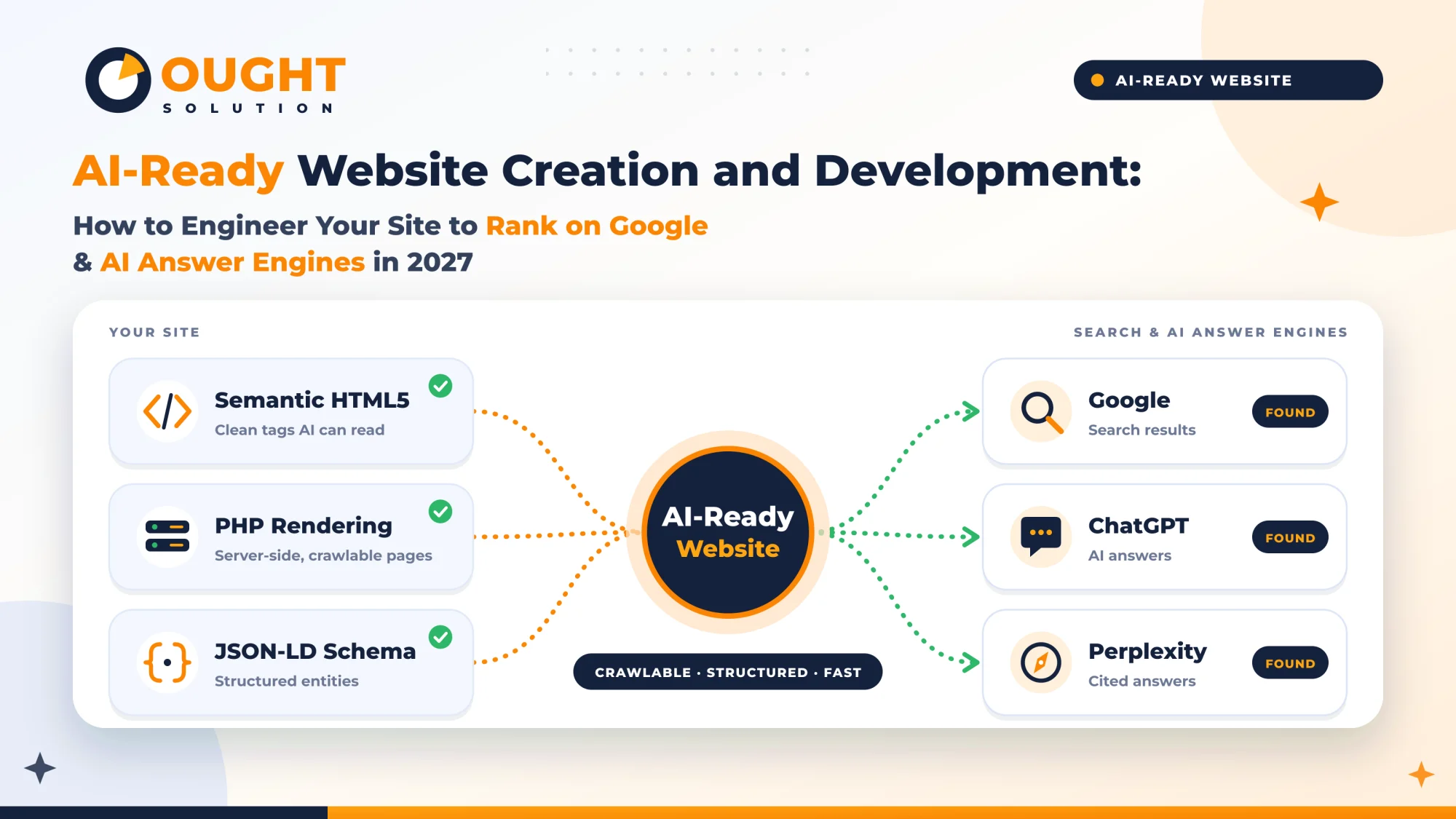
The 5 Technical Pillars of AI-Ready Website Creation and Development
To engineer a website that dominates both Google Search and Generative Engine Optimization (GEO) in 2027, development must prioritize structure and speed from the first line of code.
1. Fast Server-Side Rendering (SSR) with Clean PHP Architecture
AI crawlers prefer receiving complete, fully rendered HTML on the very first HTTP request. While heavy Single Page Applications (SPAs) force bots to execute megabytes of JavaScript just to read a headline, server-side rendering using modern PHP, MySQL, and lightweight HTML5 delivers instant, ready-to-parse markup.
Server-side rendered sites consistently achieve lower Time to First Byte (TTFB) and stronger Core Web Vitals (LCP, INP, and CLS). Faster rendering means deeper crawl coverage across your service pages, product catalogs, and blog archives.
2. Strict Semantic HTML5 Hierarchy
LLMs read document structure the same way a technical editor reads a blueprint. Replacing generic <div> soup with proper semantic tags gives answer engines explicit signals about content importance:
Use
<header>,<nav>,<main>,<article>,<section>,<aside>, and<footer>to separate core value from boilerplate navigation.Maintain a single
<h1>per page followed by logical<h2>and<h3>subheadings that mirror real user questions.Present comparisons, specs, and pricing inside true HTML
<table>elements rather than CSS-styled boxes or images.
3. Direct HTML JSON-LD Schema Markup
Structured data is the native language of AI knowledge graphs. Injecting JSON-LD schema directly into the webpage HTML <head>—rather than delaying it through client-side tag managers—ensures every crawler reads your entity data immediately.
High-impact schema types for 2027 include:
| Schema Type | Primary Purpose for AI & Google |
Organization & LocalBusiness | Establishes verified brand identity, contact details, service areas, and official social profiles (sameAs). |
Service & Product | Defines exact offerings, technical features, and pricing structures so AI engines recommend you for commercial queries. |
FAQPage & HowTo | Maps direct question-and-answer blocks that AI Overviews and Perplexity extract for instant citations. |
Article / BlogPosting | Connects authoritative insights to verified authors, publication dates, and topical entities. |
4. Flat URL Architecture and Clean Crawlability
Deeply nested folders and dynamic query-string URLs dilute topical authority. An AI-ready site uses a clean, predictable hierarchy (such as /services/web-development or /tools/roi-calculator) backed by an auto-updating XML sitemap, precise robots.txt directives allowing AI search crawlers, and a dedicated /llms.txt file that summarizes your highest-value pages in plain Markdown for LLM ingestion.
5. Citation-Worthy Content Engineering
Technical excellence opens the door; information density earns the citation. AI engines favor pages that lead sections with direct, factual answers before expanding into supporting details. Including original frameworks, measurable benchmarks, clear definitions, and structured comparison tables turns your website into a primary reference source rather than generic marketing copy.
Traditional Web Design vs. AI-Ready Web Engineering
| Feature | Traditional Website Build | AI-Ready Website Engineering (2027 Standard) |
| Rendering Method | Heavy client-side JS / bloated builders | Fast Server-Side Rendering (PHP/SSR) with instant HTML delivery |
| Code Structure | Nested <div> containers | Strict semantic HTML5 (<main>, <article>, <table>) |
| Structured Data | Missing or delayed via tag managers | Direct inline HTML JSON-LD (Organization, Service, FAQPage) |
| Search Visibility | Optimized only for basic keywords | Engineered for Google Search, AI Overviews, ChatGPT, and Perplexity |
| Performance | Slow mobile load times | Sub-second TTFB and passing Core Web Vitals globally |
How Ought Solution Engineers AI-Ready Websites for Global Growth
At Ought Solution, we build custom, high-performance websites and web applications designed from the ground up for the 2027 search landscape. Instead of locking businesses into sluggish, template-heavy platforms, our engineering team delivers clean, scalable architectures tailored to your exact commercial goals.
Our AI-ready website creation and development services include:
Custom PHP, MySQL & HTML5 Development: Ultra-fast, server-side rendered business websites, custom web portals, and e-commerce platforms built for global speed and security.
Native Technical SEO & JSON-LD Architecture: Hand-crafted semantic HTML, direct-in-HTML JSON-LD schema implementation, flat URL routing, and clean Core Web Vitals optimization.
Conversion-Focused UI/UX Design: Crisp, modern, responsive interfaces engineered with lightweight CSS and Bootstrap 5 so human visitors convert as effortlessly as AI bots crawl.
End-to-End Enterprise Automation: Seamless integration with custom ERP modules, CRM workflows, AI chatbots, and lead-capture systems.
Whether you are launching a new global brand or migrating an outdated website that is losing visibility to AI search, Ought Solution gives your business the technical foundation required to rank, get cited, and convert.
Preparing Your Digital Foundation for 2027
Search visibility is no longer won by publishing more pages—it is won by engineering clearer, faster, and more verifiable web experiences. Businesses that invest in AI-ready architecture today build a compounding authority advantage across Google Search and every emerging AI answer engine.
Ready to upgrade your online presence? Contact Ought Solution to discuss a custom, AI-ready website engineered to rank globally and turn search visibility into measurable revenue.

Ought Solution Admin is the technical editorial and solutions architecture desk at Ought Solution, a global B2B IT consulting, custom ERP software, and biometric hardware integration firm. Drawing from hands-on deployments across Manufacturing Units / Plants, healthcare diagnostics, educational campuses, and corporate…