Off-the-shelf tools force you to compromise your workflows. When an Indian enterprise is just starting out, subscribing to a ready-made cloud software suite feels like the fastest path forward. You pay a modest monthly fee, import a few spreadsheets, and start generating invoices.
Then growth happens. You add a second warehouse, expand to multi-state GST billing, integrate biometric attendance on the shop floor, or introduce custom approval hierarchies. Suddenly, the software that once saved you time becomes a bottleneck. Your team ends up exporting data into Excel every evening just to bridge gaps between disconnected modules, while your annual SaaS renewal bill climbs with every new hire.
Deciding between pre-packaged software and custom ERP software development in India comes down to one core question: Are you buying a short-term convenience, or are you investing in a long-term operational asset?
The Hidden Costs of Off-the-Shelf Software
Ready-made ERP platforms are engineered for the average global business—not your specific operational reality. While the upfront entry price looks attractive, growing Indian enterprises routinely encounter four hidden drains on Return on Investment (ROI):
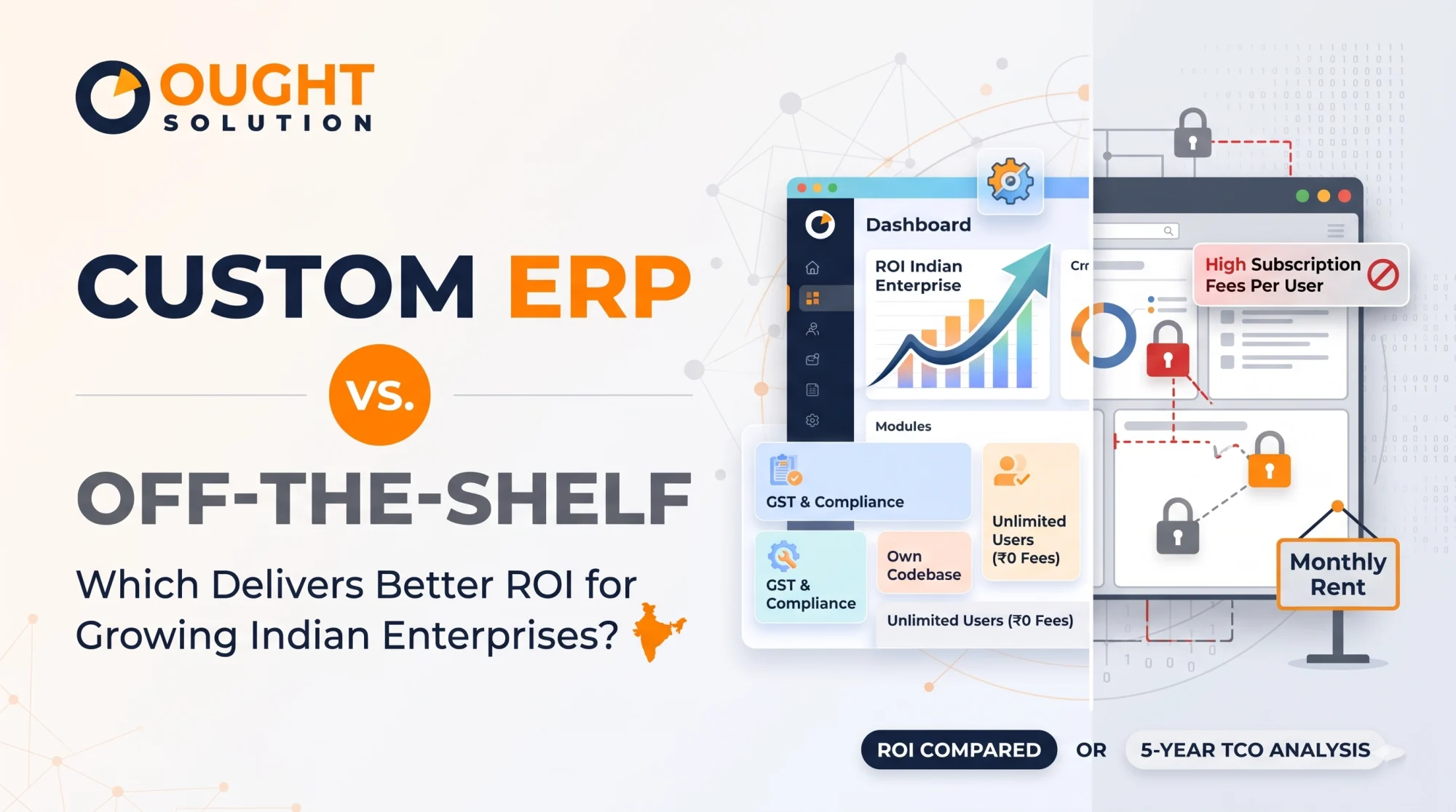
The "Per-User" Growth Tax: Most commercial SaaS platforms charge per seat, per month. Adding 50 floor supervisors, field sales executives, or branch operators can triple your recurring licensing costs overnight without adding a single new feature.
Workflow Contortions: Instead of software adapting to your proven business logic, your staff must alter how they work to fit rigid software templates. Operational workarounds slow down order fulfillment and introduce manual data-entry errors.
Bloatware You Pay For, Gaps You Patch: You end up paying for dozens of generic modules you never open, while still purchasing third-party plugins for essentials like e-Way bill generation, batch-wise inventory tracking, or canteen and shift management.
Vendor Lock-In and Surprise Hikes: When a software vendor changes its pricing tier, deprecates a legacy feature, or experiences downtime, your entire operation is held hostage.
How Custom ERP Flips the ROI Equation
Investing in custom ERP software development in India shifts your expenditure from an endless operating expense (OpEx) into a high-leverage capital asset (CapEx) that you own outright.
Zero Recurring Seat Licenses: Whether you have 25 employees today or 500 next year, you own the codebase and database. Scaling your team does not trigger punitive licensing penalties.
100% Alignment with Indian Compliance and Operations: From multi-GSTIN invoicing, TDS/TCS rules, and e-Invoicing APIs to regional distributor pricing tiers and multi-shift payroll, every rule is built natively into your workflow.
Seamless Hardware and Legacy Integration: Growing enterprises rarely run on software alone. A custom-built ERP connects directly with biometric attendance devices, thermal barcode printers, weighbridges, and existing accounting tools via unified APIs.
Competitive Advantage You Own: Your unique pricing formulas, procurement triggers, and customer service workflows are your competitive edge. Custom software locks those advantages into an automated system that competitors cannot simply buy off a shelf.
Side-by-Side Comparison: Custom ERP vs. Off-the-Shelf Software
| Evaluation Factor | Off-the-Shelf ERP / SaaS | Custom ERP Software |
| Initial Investment | Low upfront setup fee | Moderate-to-high initial development cost |
| 5-Year Total Cost (TCO) | High (compounding per-user & tier fees) | Predictable & lower long-term cost (zero seat fees) |
| Workflow Fit | 60%–75% fit; requires manual workarounds | 100% tailored to your exact business processes |
| Scalability | Expensive as headcount and branches grow | Unlimited users, branches, and modules at no extra license cost |
| Hardware Integration | Limited to pre-approved vendor plugins | Direct integration with biometric, POS, and thermal hardware |
| IP & Data Ownership | Vendor-hosted; strict export limitations | Full ownership of source code, database, and hosting |
When Should You Choose Which?
Choose Off-the-Shelf Software If:
You are an early-stage startup validating a business model with fewer than 10–15 users.
Your processes are completely standard (basic invoicing, simple ledger accounting, flat inventory) with no specialized operational rules.
You need to go live within 48 hours and plan to revisit your tech stack in 12 to 18 months.
Choose Custom ERP Software Development If:
Your team relies on spreadsheets alongside your current software to calculate commissions, track production batches, or reconcile stock.
Your annual SaaS subscription renewals are rising faster than your headcount due to per-user or transaction-volume pricing tiers.
You manage complex, multi-department workflows across manufacturing, distribution, healthcare, education, or multi-branch retail.
You need unified automation linking HR, biometric attendance, payroll, inventory, CRM, and billing into a single source of truth.
Calculating Your Real 3-to-5 Year ROI
To evaluate true ROI, look beyond Month 1 invoice figures and run a simple four-part audit:
Calculate 5-Year Licensing Spend: Multiply your current annual SaaS subscription by five, factoring in a conservative 15%–20% annual increase for user additions and tier upgrades.
Quantify "Shadow Excel" Hours: Estimate how many hours per week your managers spend exporting CSVs, cleaning data, and manually reconciling reports across disconnected apps. Multiply those hours by their hourly payroll cost.
Measure Error and Delay Costs: Factor in revenue lost from stockouts, delayed dispatch approvals, or compliance penalties caused by rigid software workflows.
Compare Against Bespoke Development: In almost every mid-sized Indian enterprise with 30+ active system users, custom ERP software breaks even between Month 14 and Month 22—and delivers pure margin savings every year thereafter.
Build Software That Fits Your Enterprise—Not the Other Way Around
Your software should accelerate your best processes, not force your team into rigid compromises. At Ought Solution, we specialize in custom ERP software development in India, designing scalable web and mobile applications, automated billing and inventory engines, and hardware-integrated attendance and payroll systems tailored to how your business actually operates.
Ready to see what a tailored ERP looks like for your operations? Contact the team at Ought Solution to map out your current bottlenecks and receive a transparent blueprint for your custom enterprise system.
Ought Solution Admin is the technical editorial and solutions architecture desk at Ought Solution, a global B2B IT consulting, custom ERP software, and biometric hardware integration firm. Drawing from hands-on deployments across Manufacturing Units / Plants, healthcare diagnostics, educational campuses, and corporate…