Your B2B website should be your highest-performing sales representative—working around the clock, qualifying high-intent buyers, and booking demos while your team sleeps. Yet for most B2B founders, the company website is little more than a slow, static brochure buried on page three of Google.
When prospects click a link and wait four seconds for a bloated page to render, they bounce straight to a competitor. When search engines and AI answer engines crawl messy, unstructured HTML, they fail to understand what your business actually sells.
Fixing this does not come down to publishing more generic blog posts or buying backlinks. It requires technical SEO web application development—an engineering-first approach that treats search visibility and conversion speed as core architectural requirements rather than marketing afterthoughts. Specifically, combining Core Web Vitals (CWV) optimization with JSON-LD Schema Markup turns an underperforming domain into a predictable, 24/7 lead generation engine.
Why Traditional B2B Websites Fail to Rank and Convert
Many B2B companies launch their sites on heavy, off-the-shelf page builders overloaded with unoptimized scripts, third-party tracking pixels, and generic templates. While they might look acceptable in a design mockup, they fail under real-world network conditions:
Invisible Pipeline Leakage: B2B buyers research solutions on mobile devices between meetings and on corporate laptops. Every extra second of load delay directly increases form abandonment before a prospect ever reads your value proposition.
Crawl Budget & Indexing Friction: Search engines evaluate real-user field data (via the Chrome User Experience Report) rather than lab scores alone. If your site fails real-world performance benchmarks, Google deprioritizes your pages against faster competitors.
Entity Ambiguity: Without structured data, search crawlers have to guess whether your page is a software product, an enterprise service, a case study, or a directory listing—costing you rich snippets and high-intent commercial queries.
Pillar 1: Core Web Vitals as a B2B Conversion Multiplier
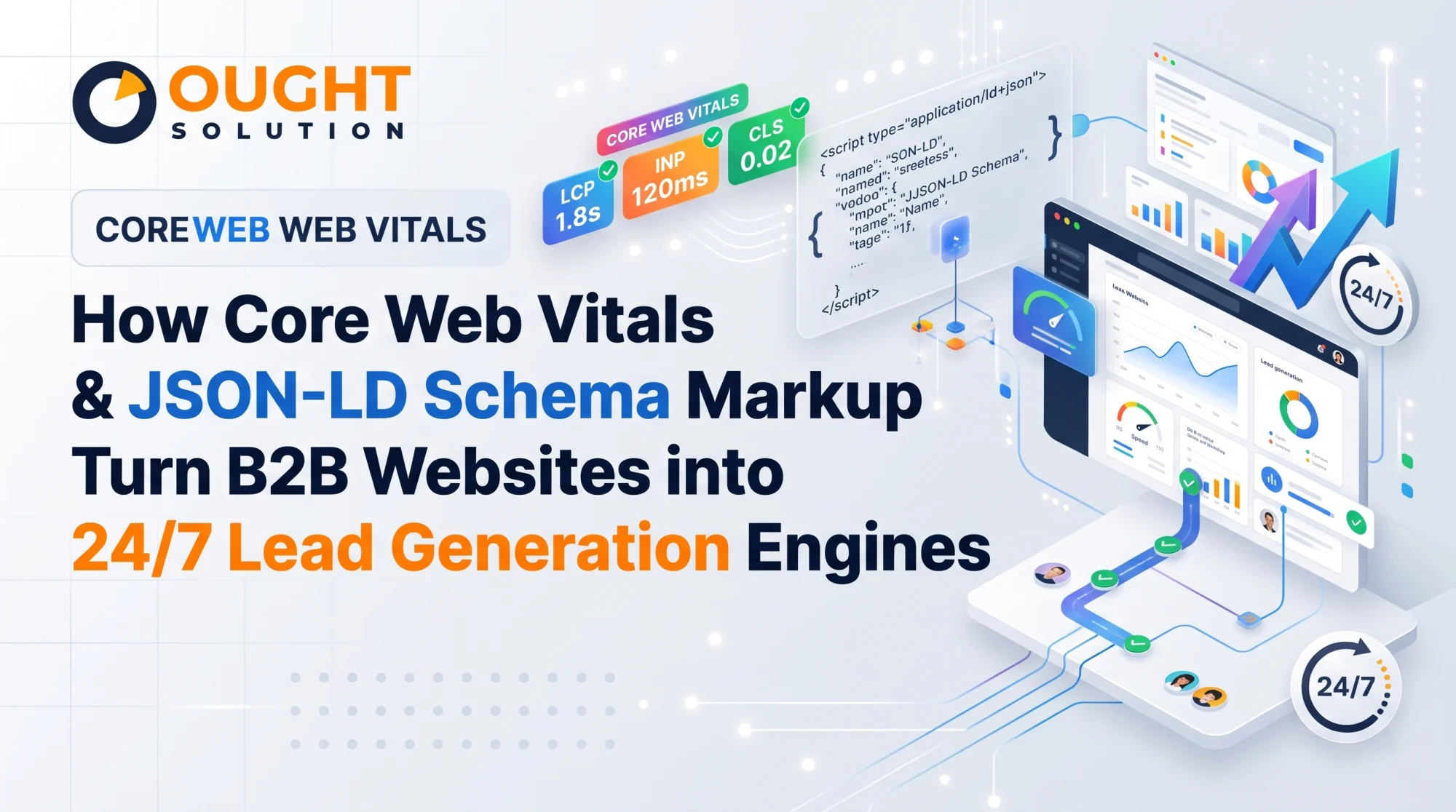
Google’s Core Web Vitals measure real-world user experience across three specific thresholds at the 75th percentile of visitor traffic. Passing all three signals to Google—and your buyers—that your web application is reliable, modern, and built for frictionless interaction.
| Core Web Vital Metric | What It Measures | Google "Good" Threshold | B2B Lead Generation Impact |
| Largest Contentful Paint (LCP) | Loading speed of the main above-the-fold hero content | 2.5 seconds or less | Prevents immediate bounce when executives land on your service or landing pages. |
| Interaction to Next Paint (INP) | Visual responsiveness across all clicks, taps, and form inputs | 200 milliseconds or less | Ensures ROI calculators, multi-step demo forms, and navigation menus feel instantaneous. |
| Cumulative Layout Shift (CLS) | Visual stability while assets and fonts load | 0.1 or less | Stops buttons from jumping mid-click, preserving executive trust and form completion. |
How Engineering-First Development Solves CWV
Achieving green Core Web Vitals across an entire B2B site requires clean application architecture rather than surface-level caching plugins:
Eliminating Render-Blocking Overhead: Custom web applications inline critical CSS, defer non-essential JavaScript, and serve next-generation image formats (
WebP/AVIF) with explicit width and height dimensions to eliminate layout shifts.Main-Thread Optimization for INP: Heavy chat widgets, analytics suites, and unoptimized DOM trees freeze the browser's main thread. Splitting long tasks and prioritizing UI event handlers keeps interactive lead-capture tools responsive under 200ms.
Fast Server Response (TTFB): Clean backend architecture—paired with edge caching, optimized database queries, and lightweight server footprints—ensures the initial HTML document reaches the browser immediately.
Pillar 2: JSON-LD Schema Markup for Search & AI Visibility
If Core Web Vitals make your website fast for humans, JSON-LD (JavaScript Object Notation for Linked Data) makes your business unmistakable to machines.
JSON-LD is a lightweight structured data format embedded directly into your webpage’s HTML <head> or <body>. Instead of forcing search engines to infer context from unstructured paragraphs, JSON-LD explicitly defines your organization, software products, B2B services, pricing models, and verified client reviews using standardized Schema.org vocabulary.
Why Direct HTML Embedding Beats Tag Manager Injection
Many marketing teams attempt to inject JSON-LD dynamically via Google Tag Manager. However, dynamic client-side injection forces crawlers to execute JavaScript before discovering your structured data—introducing indexing delays or missed entities. Embedding clean, server-rendered JSON-LD directly in the initial HTML response guarantees instant discovery by search engine bots and AI search crawlers alike.
Essential Schema Types for B2B Lead Engines
Organization&LocalBusiness: Connects your brand name, logo, headquarters, contact channels, and social profiles into a unified Knowledge Graph entity.Service&SoftwareApplication: Defines exact service offerings, target industries, operating systems, and capability scopes so you rank for specific commercial-intent searches.FAQPage&HowTo: Captures expanded SERP real estate and directly answers buyer objections before they even click through to your site.BreadcrumbList: Clarifies site hierarchy, helping Google index deep solution pages cleanly.
How CWV and JSON-LD Work Together to Compound Pipeline
When you build a B2B web platform with both performance engineering and semantic data from day one, the two systems reinforce each other:
Higher Rankings & Richer Snippets: Structured data unlocks enhanced search appearances and stronger topical authority, driving higher click-through rates (CTR) from qualified B2B buyers.
Lower Bounce Rates & Deeper Engagement: Because your LCP is under 2.5 seconds and your INP is under 200ms, those high-intent visitors stay on the page, explore case studies, and complete lead forms.
Positive Behavioral Feedback Loops: Strong engagement and low bounce rates signal high user satisfaction back to search ranking systems, steadily pushing your core service pages higher in organic results without ongoing ad spend.
Ready to Turn Your Website into a High-Ranking Growth Engine?
A slow, poorly structured website silently taxes every marketing dollar you spend. If your B2B platform struggles with sluggish load times, failing Search Console vitals, or stagnant organic rankings, patching an outdated template won't solve the root problem.
At Ought Solution, we specialize in technical SEO web application development—engineering custom, high-speed web platforms, ERP integrations, and conversion-focused B2B websites built with green Core Web Vitals and server-rendered JSON-LD schema at their core.
Contact Ought Solution today for a technical architecture and SEO performance audit, and let’s build a digital platform that generates qualified B2B leads 24/7.

Ought Solution Admin is the technical editorial and solutions architecture desk at Ought Solution, a global B2B IT consulting, custom ERP software, and biometric hardware integration firm. Drawing from hands-on deployments across Manufacturing Units / Plants, healthcare diagnostics, educational campuses, and corporate…